

Your customers ask about "natural flavors" on your ingredient labels. You can’t explain exactly what’s in them. I’ll break down the FDA definition, sourcing requirements, and what B2B flavor buyers need to know.
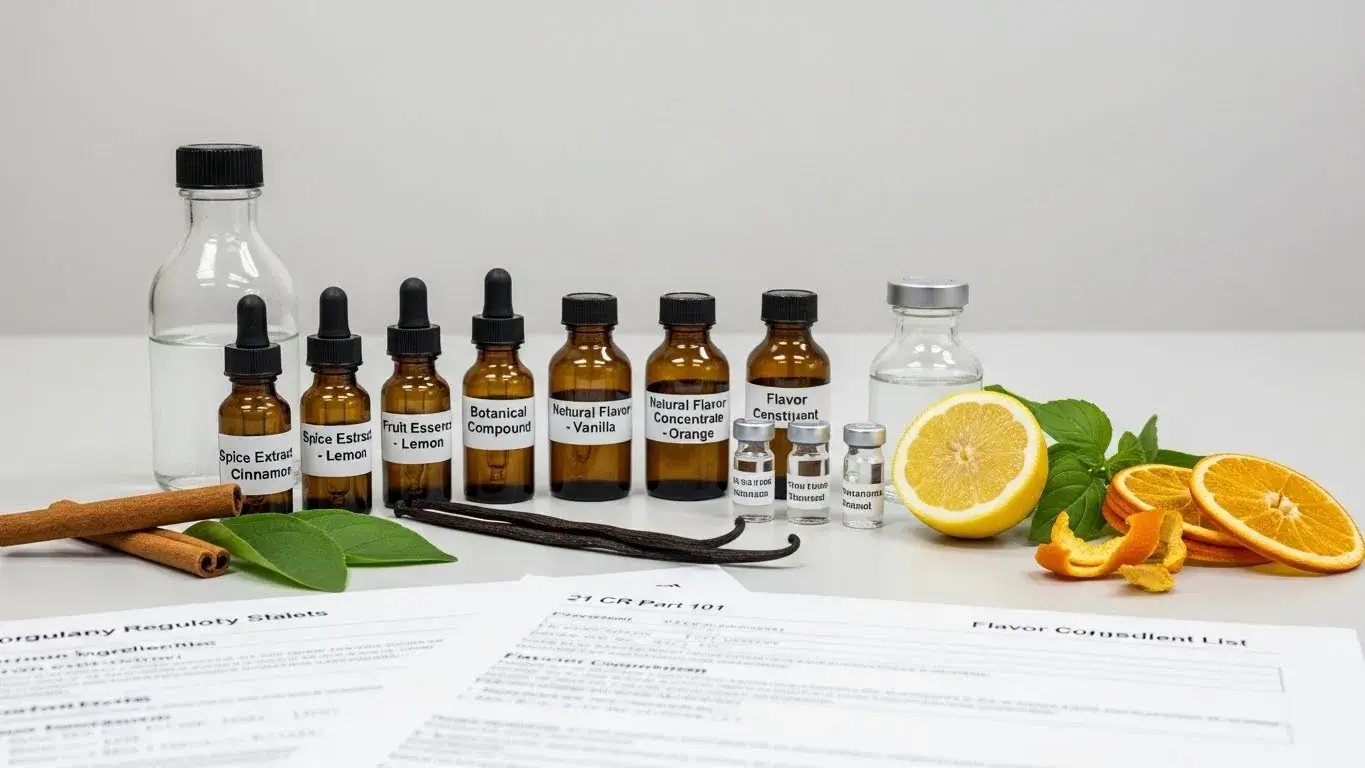
"Natural flavor" is a regulatory term defined by FDA’s 21 CFR 101.22(a)(3)1. It refers to flavoring substances extracted or derived from plant or animal sources—including spices, fruits, vegetables, herbs, meat, dairy, eggs, or fermentation products—through processes like distillation, roasting, or enzymolysis. These ingredients are used solely for taste, not nutrition.
In this guide, I’ll explain how natural flavors are made, how they differ from artificial flavors, and what B2B ingredient buyers must understand for compliance and customer communication.
What Exactly Does "Natural Flavor" Mean on a Food Label?
The term "natural flavor" appears on almost every packaged food. But few people understand what it actually means. The definition is more technical than most realize.
Per FDA’s 21 CFR 101.22(a)(3), "natural flavor" means essential oils, oleoresins, essences, extractives, protein hydrolysates, distillates, or products of roasting, heating, or enzymolysis from spices, fruits, vegetables, herbs, bark, buds, roots, leaves, meat, seafood, poultry, eggs, dairy, or fermentation products. The primary function must be flavoring, not nutritional.
The Complete FDA Definition
Let me break down the official definition piece by piece:
Source Requirements:
Natural flavors must come from:
- Plant materials (spices, fruits, vegetables, herbs, bark, buds, roots, leaves)
- Animal materials (meat, seafood, poultry, eggs, dairy)
- Fermentation products (yeast, bacteria-derived compounds)
Allowed Processes:
- Extraction (essential oils, oleoresins)
- Distillation
- Roasting
- Heating
- Enzymolysis (enzyme-assisted breakdown)
- Fermentation
Functional Requirement:
The ingredient’s primary purpose must be flavoring. It cannot be used primarily for nutritional value or as a food ingredient itself.
What "Natural" Doesn’t Mean
Many consumers misunderstand "natural flavor" to mean:
- ❌ Healthy
- ❌ Organic
- ❌ Unprocessed
- ❌ Single-ingredient
- ❌ Nutrient-rich
The term only describes the origin of the raw materials. It says nothing about:
- Processing intensity
- Number of components
- Health effects
- Environmental impact
"Natural flavor is the fourth most common ingredient2 on food labels in the United States. A single natural flavor may contain 50-100 different chemical compounds blended by flavorists." — EWG Research
Why This Matters for B2B Buyers
If you’re sourcing natural flavors, you need to understand:
- Label compliance: Your supplier must provide documentation confirming natural origin
- Customer communication: You need accurate language for your marketing
- Regulatory differences: US "natural" differs from EU definitions
- Certification requirements: Organic, kosher, halal, and vegan claims require additional verification
How Are Natural Flavors Derived and Processed?
Understanding production methods helps you evaluate supplier quality and make accurate claims about your ingredients.
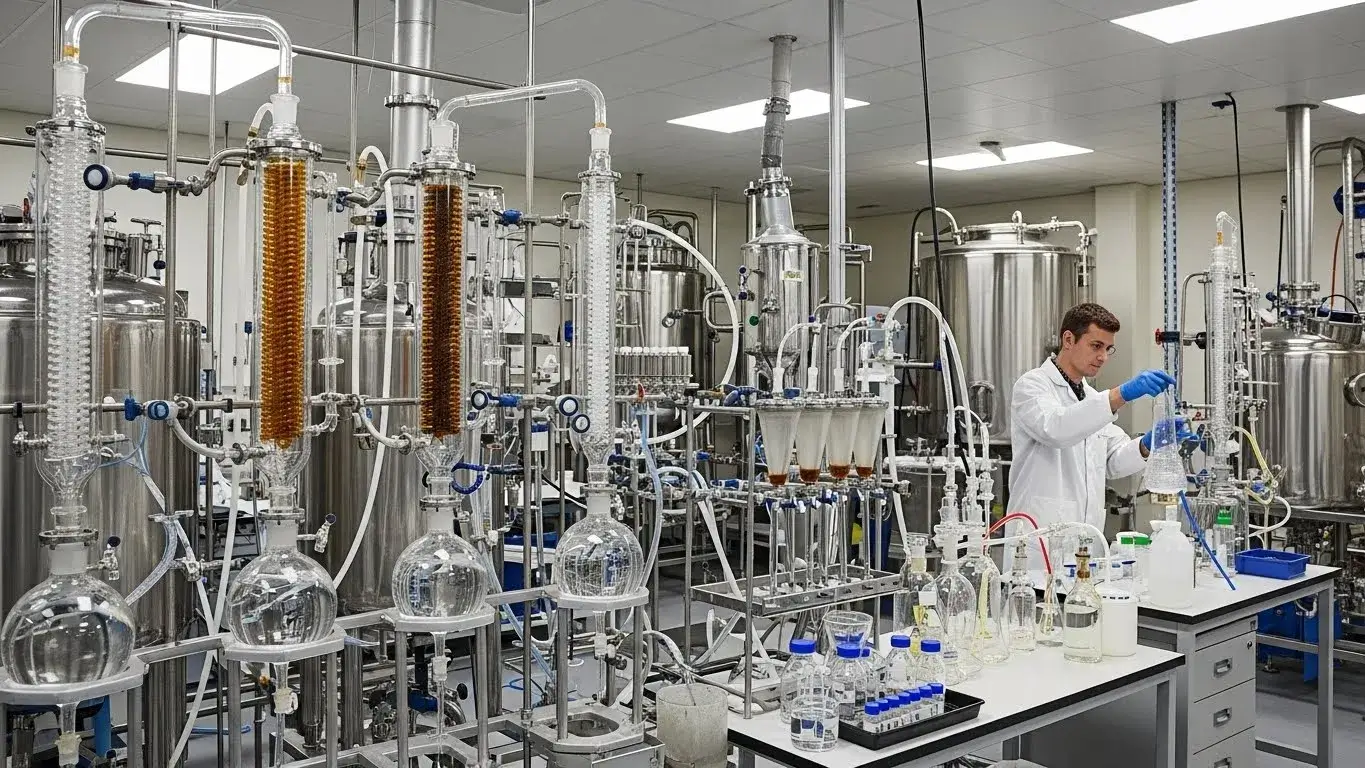
Natural flavors are derived through extraction (using solvents, steam, or pressure), distillation (separating volatile compounds), enzymatic processing (breaking down proteins or carbohydrates), fermentation (using microorganisms), or thermal processing (roasting, heating). The extracted compounds are then blended with carriers like ethanol, propylene glycol, or vegetable glycerin.
Common Extraction Methods
Steam Distillation
Steam passes through plant material. Volatile aroma compounds evaporate with the steam. The condensed mixture separates into essential oil and hydrosol. This method works well for:
- Mint
- Citrus oils
- Herbs like basil and oregano
Solvent Extraction
Chemical solvents dissolve flavor compounds from raw materials. The solvent is then removed. Common solvents include:
- Ethanol (food-grade alcohol)
- Hexane (for some oil extractions)
- Propylene glycol
- CO2 (supercritical extraction)
Enzymatic Processing (Enzymolysis)
Enzymes break down proteins, carbohydrates, or fats to release flavor compounds. This method creates:
- Savory/umami flavors from protein hydrolysis
- Fruity notes from carbohydrate breakdown
- Butter/dairy notes from fat modification
Fermentation
Microorganisms (yeast, bacteria) produce flavor compounds as metabolic byproducts. Examples include:
- Vanillin from ferulic acid fermentation
- Citrus notes from yeast
- Savory compounds from bacterial cultures
Carriers and Processing Aids
Natural flavors rarely exist as pure compounds. They’re typically dissolved in carriers:
| Carrier | Function | Common Use |
|---|---|---|
| Ethanol | Solvent, preservative | Liquid flavors |
| Propylene glycol | Solvent, humectant | Concentrated flavors |
| Vegetable glycerin | Solvent, sweetener | Natural/organic products |
| MCT oil | Carrier oil | Oil-soluble flavors |
| Maltodextrin | Encapsulation | Powdered flavors |
These carriers are considered "incidental additives" and don’t require separate labeling under FDA rules.
Biotech-Derived Natural Flavors
Modern biotechnology has expanded natural flavor production:
Fermentation-derived ingredients:
- Vanillin from yeast3 (instead of vanilla beans)
- Citrus compounds from engineered microorganisms
- Dairy flavors without animal inputs
These ingredients qualify as "natural" under FDA rules because they use biological processes and natural substrates. They offer:
- Consistent supply
- Lower environmental impact
- Scalability for large production
What’s the Difference Between Natural and Artificial Flavors?
This distinction affects labeling, marketing, and regulatory compliance. Both categories have specific definitions.
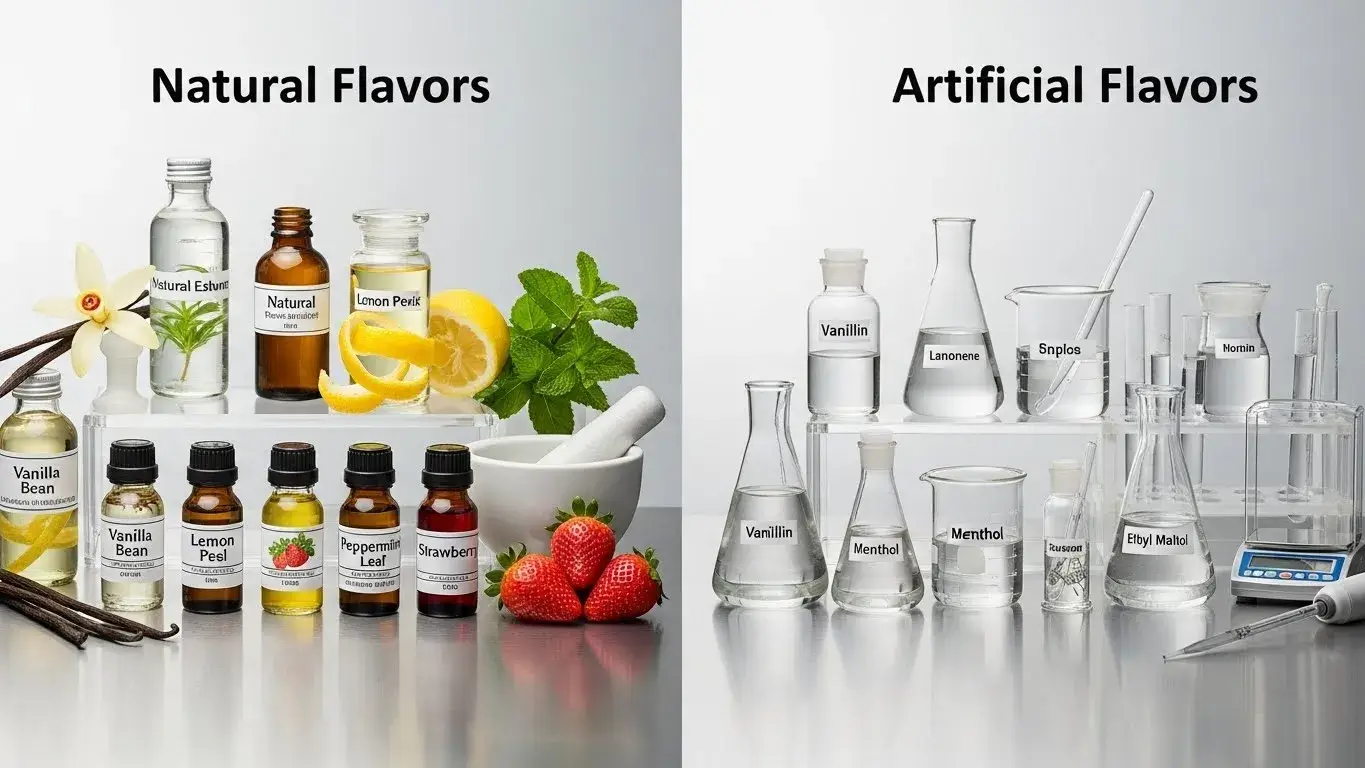
Natural flavors must derive from plant or animal sources through physical or enzymatic processes. Artificial flavors are chemically synthesized compounds that may or may not exist in nature. Both are regulated as GRAS (Generally Recognized as Safe) by FDA. The chemical structures may be identical, but the source and process differ.
Side-by-Side Comparison
| Factor | Natural Flavors | Artificial Flavors |
|---|---|---|
| Source | Plant/animal/fermentation | Laboratory synthesis |
| Regulation | 21 CFR 101.22(a)(3) | 21 CFR 101.22(a)(1) |
| Complexity | Often 50-100+ compounds | Usually simpler blends |
| Consistency | Variable by batch | Highly consistent |
| Cost | 2-3x higher | Lower |
| Consumer perception | Positive ("clean label") | Negative |
| Label requirement | "natural flavor" | "artificial flavor" |
The Chemistry Perspective
Here’s an important point: Natural and artificial versions of the same compound are chemically identical.
For example, vanillin:
- Natural vanillin (from vanilla beans or fermentation)
- Artificial vanillin (synthesized from guaiacol or lignin)
Both have the exact same molecular structure: C₈H₈O₃. Your taste buds cannot distinguish between them.
The difference is origin and process, not chemistry.
Why Natural Costs More
Natural flavors typically cost 2-10x more than artificial equivalents because:
- Raw material costs: Agricultural products have variable yields
- Processing complexity: Extraction is less efficient than synthesis
- Supply limitations: Weather, seasons, and geography affect availability
- Certification requirements: Organic, kosher, halal add costs
- Market demand: Clean-label trends drive premium pricing
Labeling Requirements
FDA requires specific label declarations:
- "Natural flavor" — only natural-derived ingredients
- "Artificial flavor" — only synthetic ingredients
- "Natural and artificial flavor" — combination of both
If a flavor characterizes the product (like "strawberry flavored"), additional rules apply about the source of that characterizing flavor.
Are Natural Flavors Safe and How Are They Regulated?
Safety questions arise frequently. Understanding the regulatory framework helps you communicate confidently with customers.
Natural flavors are regulated as GRAS (Generally Recognized as Safe)4 under FDA oversight. FEMA (Flavor and Extract Manufacturers Association) conducts expert safety reviews of over 2,000 flavoring substances annually. Reported adverse reactions are below 0.5% of the population. Top-8 allergens must be declared if present in natural flavors.

The GRAS System
GRAS status means a substance is "generally recognized, among qualified experts, as having been adequately shown to be safe under the conditions of its intended use."
For flavors, this safety determination comes from:
- Published scientific literature
- Expert panel review (FEMA Expert Panel)
- History of safe use
- Toxicological data
FEMA’s Role
The Flavor and Extract Manufacturers Association (FEMA)5 operates an independent expert panel that:
- Reviews safety data for flavoring substances
- Assigns FEMA-GRAS numbers to approved ingredients
- Publishes findings in peer-reviewed journals
- Updates assessments based on new science
Over 2,700 substances have FEMA-GRAS status. This provides a practical framework for B2B buyers to verify ingredient safety.
Allergen Disclosure Requirements
Natural flavors can contain allergens. FDA requires disclosure of the "Big 8" (now 9 with sesame):
- Milk
- Eggs
- Fish
- Shellfish
- Tree nuts
- Peanuts
- Wheat
- Soybeans
- Sesame
If your natural flavor contains any of these allergens, they must appear on the label—either in the ingredient list or a "Contains" statement.
What About MSG?
A common concern: Does "natural flavor" hide MSG (monosodium glutamate)?
The answer: No, but it’s complicated.
- If MSG is added directly, it must be labeled as "monosodium glutamate"
- Some natural flavors use protein hydrolysis, which creates free glutamates
- These glutamates are not labeled as MSG because they weren’t added as MSG
- Sensitive individuals may react to these free glutamates
For B2B buyers, request detailed specifications showing glutamate content if this matters for your application.
Can Natural Flavors Contain Allergens or Animal-Derived Ingredients?
This question matters for customers with dietary restrictions. The answer affects your labeling and marketing claims.
Yes, natural flavors can contain both allergens and animal-derived ingredients. Potential animal sources include meat extracts, dairy derivatives, and egg-based compounds. For meat and poultry products, USDA requires animal-origin disclosure6. For other foods, only top-9 allergens require labeling7. About 95% of natural flavors are plant-derived, but verification is essential for vegan or allergen-free claims.

Animal-Derived Natural Flavors
Natural flavors can come from:
- Meat extracts (beef, chicken, pork)
- Seafood extracts
- Dairy derivatives (butter, cheese cultures)
- Egg-based compounds
- Honey
- Castoreum (beaver gland secretion—rare, mostly historical)
Industry reality: Over 95% of commercial natural flavors are plant-derived. Animal sources are less common due to:
- Higher cost
- Regulatory complexity
- Consumer preference trends
- Availability issues
Labeling Rules by Product Type
| Product Category | Disclosure Requirement |
|---|---|
| Meat/poultry products | Must specify animal source (e.g., "natural chicken flavor") |
| General foods | Only top-9 allergens required |
| Organic products | Stricter sourcing rules apply |
| Kosher/Halal | Certification verifies acceptable sources |
Verifying for Dietary Claims
If you’re making vegan, vegetarian, allergen-free, or religious dietary claims, you need:
- Supplier declaration: Written confirmation of source materials
- Specifications: Detailed ingredient breakdown
- Certifications: Third-party verification (vegan, kosher, halal)
- Testing: Analytical verification if required
Don’t rely on the generic "natural flavor" label. Request complete documentation from your supplier.
Why Do Food Manufacturers Add Natural Flavors to Products?
Understanding manufacturer motivations helps you position your ingredients effectively.
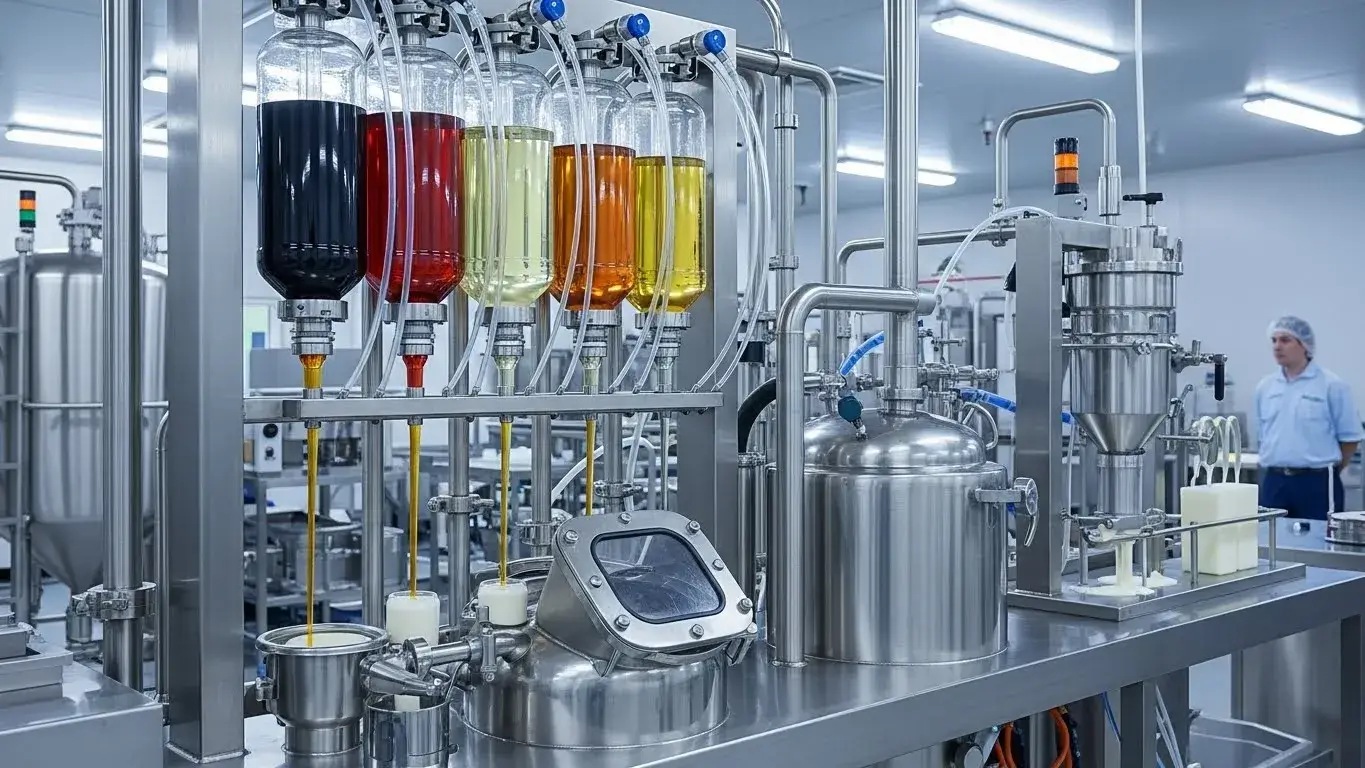
Manufacturers add natural flavors to ensure consistent taste across batches, compensate for processing losses, meet clean-label consumer demands, reduce costs versus whole ingredients, and create specific flavor profiles. The natural flavors market is growing at 7% CAGR8, driven by 72% of consumers preferring "natural" ingredients on labels.
Primary Reasons for Use
Consistency
Natural raw materials vary by season, region, and harvest. A strawberry from California tastes different than one from Spain. Natural flavors standardize taste across production runs.
Processing Compensation
Food processing destroys volatile flavor compounds. Heating, freezing, and drying all reduce natural taste. Added flavors restore the expected sensory experience.
Cost Efficiency
Whole ingredients cost more than flavor compounds. Using a small amount of concentrated natural flavor is cheaper than using large amounts of the actual food.
Clean-Label Positioning
"Natural flavor" appears better to consumers than "artificial flavor." Brands reformulate to remove artificial ingredients and capture clean-label market share.
Flavor Innovation
Natural flavors enable taste profiles impossible with whole foods alone. Exotic, seasonal, or unavailable flavors become accessible year-round.
Market Growth Data
The natural flavors market shows strong growth:
| Metric | 2025 Value | 2030+ Projection | CAGR |
|---|---|---|---|
| Global food flavors market | $20.26B | $25.91B (2030) | 5.04% |
| Natural flavors segment | $6.37-8.03B | $8.95-18.16B (2035) | 7-8.5% |
| Natural & organic flavors | $9.64B | $18.07B (2032) | 9.39% |
Key drivers:
- 72% of consumers prefer natural ingredients
- 55% willing to pay premium for natural
- 39% of new product launches feature clean-label claims
B2B Opportunity
For ingredient suppliers, this growth means:
- Expanding demand for documented natural flavors
- Premium pricing opportunity for certified products
- Need for traceable, sustainable sourcing
- Opportunity in biotech-derived naturals
Conclusion
"Natural flavor" has a specific FDA definition requiring plant or animal origin. B2B buyers must verify sourcing, allergens, and certifications to make accurate claims and serve customers with dietary restrictions effectively.
-
The Electronic Code of Federal Regulations (eCFR) provides the official FDA definition of "natural flavor" under 21 CFR 101.22(a)(3), specifying the allowed sources (plant, animal, fermentation) and processes (distillation, extraction, enzymolysis) that qualify a flavoring substance as "natural." ↩
-
The Environmental Working Group’s Food Scores database analyzed over 80,000 food products and found that "natural flavor" is the fourth most common ingredient listed on food labels, appearing more frequently than any ingredient except salt, water, and sugar. ↩
-
This peer-reviewed scientific article in Microbial Cell Factories explains how biotechnology companies now produce vanillin through yeast fermentation using ferulic acid from rice bran, demonstrating the commercial feasibility of microbial production as a sustainable alternative to vanilla bean extraction. ↩
-
The FDA’s GRAS (Generally Recognized as Safe) program provides the regulatory framework for evaluating food ingredient safety, requiring that substances be recognized by qualified experts as safe under their intended conditions of use. ↩
-
FEMA’s GRAS program is the longest-running industry safety evaluation system for flavor ingredients, with an independent expert panel that has reviewed over 2,700 flavoring substances since 1960 using the same safety standard required by FDA. ↩
-
The USDA’s Food Safety and Inspection Service (FSIS) requires that natural flavors derived from animal sources must be specifically identified by species on meat and poultry product labels, unlike FDA-regulated products which only require top-9 allergen disclosure. ↩
-
The FDA’s food allergen labeling page explains FALCPA requirements, including the nine major allergens (milk, eggs, fish, shellfish, tree nuts, peanuts, wheat, soybeans, and sesame) that must be declared on food labels, including when present in natural flavors. ↩
-
Grand View Research’s market analysis projects the global natural flavors market to grow at 7.5% CAGR from 2024-2030, driven by consumer preference for clean-label products and the food industry’s transition away from synthetic alternatives. ↩