

You have fragrance oils but aren’t sure about all their applications. Different industries require different usage rates and safety standards. I’ll show you every major use case and the proper dilution rates for commercial success.
Fragrance oils can be used in candles/wax melts (6-12% of wax weight), personal care products (1-5%), cleaning products (0.5-2%), perfumes (10-20% in carrier), reed diffusers (5-10%), and air fresheners. Each application requires specific IFRA-compliant formulations1 and proper dilution. Unlike essential oils, fragrance oils are synthetic blends designed for stability, strong throw, and cost-effective commercial production across home, personal care, and industrial sectors.
In this guide, I’ll cover usage rates by application, safety requirements, and emerging opportunities for B2B fragrance buyers.
What Are the Main Commercial Applications for Fragrance Oils?
Fragrance oils serve multiple industries. Understanding the full range of applications helps you identify new market opportunities.
Fragrance oils are commercially used in five main sectors: home fragrance (candles, diffusers, room sprays), personal care (lotions, soaps, body products), household cleaning (detergents, fabric softeners), fine fragrance (perfumes, body mists), and industrial applications (odor masking, functional products). The global fragrance market2 shows cosmetics at 29% share, household at 16%, with home fragrance leading DIY and consumer segments.
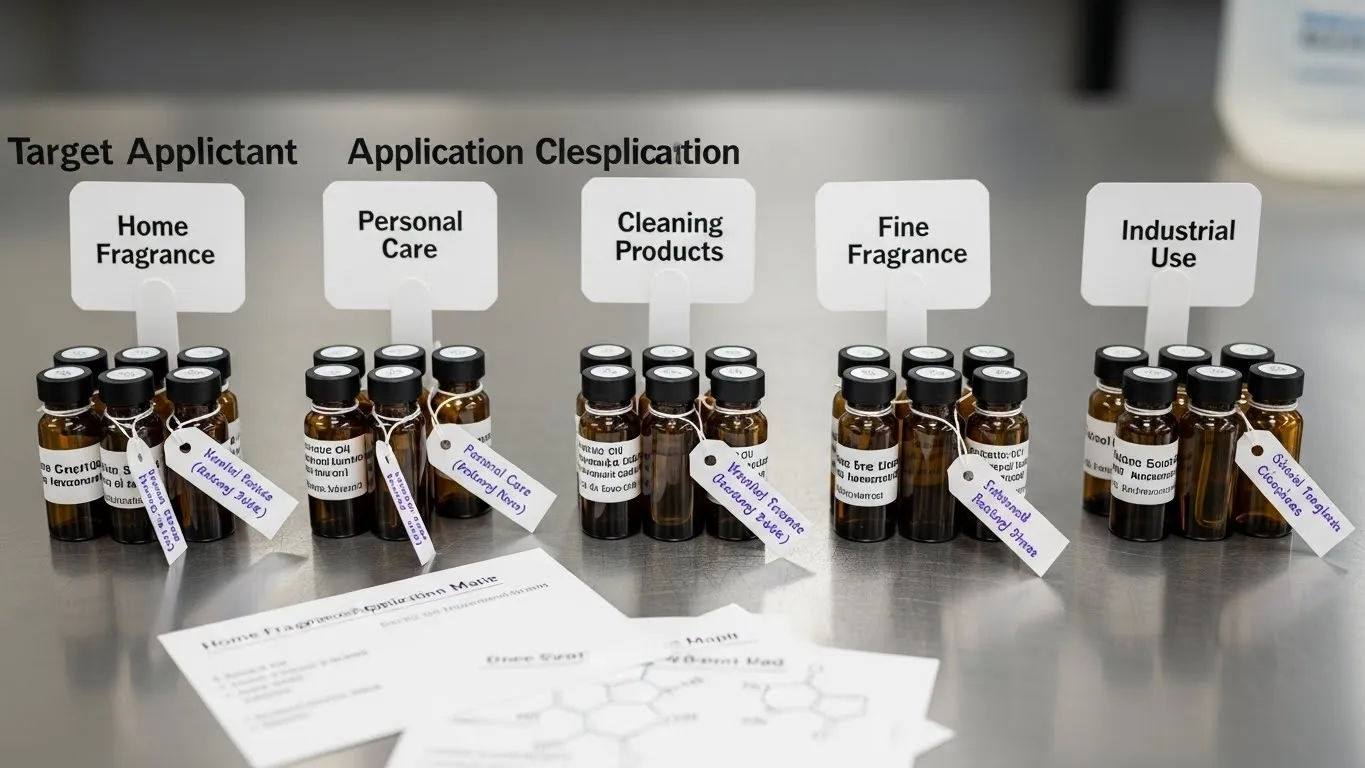
Application Overview by Industry
| Application Category | Typical Usage Rate | Key Industries | Market Position |
|---|---|---|---|
| Candles & Wax Melts | 6-12% of wax weight | Home fragrance | Leads consumer DIY |
| Personal Care | 1-5% of product | Cosmetics (29% share) | Fastest growing |
| Cleaning/Laundry | 0.5-2% of product | Household (16% share) | Stable demand |
| Perfumes/Roll-ons | 10-20% in carrier | Fine fragrance | Premium segment |
| Air Fresheners/Diffusers | 5-10% of product | Home care | Growing steadily |
| Industrial | 0.1-1% | Manufacturing | B2B dominated |
Why These Applications Dominate
Home Fragrance
Candles and diffusers represent the largest consumer fragrance market. Fragrance oils are preferred over essential oils because:
- Better heat stability in wax
- Stronger scent throw
- More consistent performance
- Lower cost per unit
- Wider variety of scents
Personal Care
The cosmetics industry uses fragrance oils in lotions, shampoos, body washes, and bath products. This sector is growing fastest due to:
- Wellness and self-care trends
- Customization demands
- Clean beauty movement
- Premium product positioning
Cleaning Products
Household cleaners, detergents, and fabric softeners use fragrance oils to:
- Mask chemical odors
- Create "clean" perception
- Differentiate products
- Enhance user experience
Market Insights for B2B Buyers
Key trends shaping fragrance oil demand:
- Wellness integration: 29% of the market now focuses on cosmetics/aromatherapy
- Clean label: Phthalate-free and sustainable sourcing are standard expectations
- Customization: B2B buyers increasingly want signature scents
- Performance focus: Stronger throw and longer-lasting formulations preferred
How Are Fragrance Oils Used in Home Fragrance Products?
Home fragrance is the largest application category for fragrance oils. Multiple product types serve this market.
Home fragrance applications include candles (6-12% in wax), wax melts (8-12%), reed diffusers (5-10% in carrier oil), room sprays (10-20% in alcohol/water), potpourri (direct application), and simmer pots (diluted in water with emulsifier). Fragrance oils outperform essential oils3 in home fragrance due to superior heat stability, stronger scent throw, and longer-lasting performance.

Home Fragrance Usage Guide
| Product Type | Usage Rate | Carrier/Medium | Performance Notes |
|---|---|---|---|
| Soy candles | 6-10% | Soy wax | Cure 1-2 weeks |
| Paraffin candles | 8-12% | Paraffin wax | Strong hot throw |
| Wax melts | 8-12% | Various wax | Higher load for intensity |
| Reed diffusers | 5-10% | Light carrier oil | Evaporation-based release |
| Room sprays | 10-20% | Alcohol/water blend | Requires emulsifier |
| Linen sprays | 15% | Witch hazel/alcohol | Direct fabric application |
| Car fresheners | Direct | Felt/wood/ceramic | Passive evaporation |
Candle-Specific Considerations
Candles remain the largest home fragrance category. Key factors for success:
Wax Compatibility
Different waxes hold fragrance differently:
- Soy: 6-10% load, requires soy-specific oils
- Paraffin: 8-12% load, strongest throw
- Coconut blends: 6-8% load, clean burning
Cure Time
All candles require curing after pouring:
- Soy: 1-2 weeks minimum
- Paraffin: 3-7 days
- Coconut: 7-10 days
During cure, fragrance binds with wax4. Testing before cure gives false results.
Hot vs. Cold Throw
- Cold throw: Scent strength when unlit
- Hot throw: Scent strength when burning
Some oils excel at one but not the other. Testing both is essential.
Reed Diffuser Formulation
Reed diffusers are growing in popularity for continuous scenting:
Basic Formula:
- 70-80% carrier oil (light mineral oil or DPG)
- 20-30% fragrance oil
- Reed sticks (rattan or fiber)
Performance Factors:
- Lighter carriers wick better
- More reeds = faster scent release
- Fragrance load affects longevity vs. intensity
How Do Personal Care Products Use Fragrance Oils?
Personal care represents the fastest-growing fragrance oil application. Multiple product categories exist within this sector.
Personal care applications include body lotions (1-3%), shampoos and conditioners (0.5-2%), bar soaps (2-4%), liquid soaps (1-2%), bath bombs (2-3%), body scrubs (2-5%), massage oils (5-15% in carrier), and rollerball perfumes (10-20% in carrier). All skin-contact products require IFRA-compliant, skin-safe grades with proper usage rates to prevent irritation.

Personal Care Usage Rates
| Product Type | Usage Rate | Safety Notes |
|---|---|---|
| Body lotion | 1-3% | Leave-on product, lowest rates |
| Face cream | 0.5-1% | Sensitive area, minimal fragrance |
| Shampoo | 0.5-2% | Rinse-off, can go slightly higher |
| Conditioner | 0.5-1.5% | Leave-in effect, lower rates |
| Bar soap (cold process) | 2-4% | Survives saponification |
| Liquid soap | 1-2% | Pre-made base, easy blending |
| Bath bombs | 2-3% | Dilutes in bath water |
| Sugar/salt scrubs | 2-5% | Rinse-off, oil base |
| Body oil | 5-15% | Direct carrier dilution |
| Roll-on perfume | 10-20% | Concentrated application |
IFRA Compliance for Skin-Contact Products
The International Fragrance Association (IFRA)5 sets maximum usage levels for fragrance ingredients in different product categories:
IFRA Categories for Personal Care:
- Category 1: Lip products (strictest limits)
- Category 4: Fine fragrance
- Category 5A: Body lotions (leave-on)
- Category 9: Bar soap (rinse-off)
- Category 10: Shampoo (rinse-off)
Why IFRA Matters:
- Prevents skin sensitization
- Ensures product safety
- Required by retailers
- Protects brand reputation
Always request IFRA certificates from your fragrance supplier before formulating.
Formulation Tips for Personal Care
Oil-Based Products
Fragrance oils mix easily with oil-based formulations:
- Body oils: Add directly to carrier
- Massage oils: Blend thoroughly
- Balms: Add at lower temperatures
Water-Based Products
Fragrance oils don’t mix with water naturally:
- Use solubilizers (polysorbate 20/80)6
- Add to oil phase, not water phase
- Emulsify properly before final mixing
Cold Process Soap
Fragrance must survive saponification:
- Use soap-safe grades
- Add at trace
- Some fragrances accelerate trace
Can Fragrance Oils Be Used in Cleaning Products?
The cleaning products industry uses significant fragrance volumes. Scent plays a major role in consumer perception of "clean."
Fragrance oils are used in household cleaners (0.5-1%), laundry detergents (0.5-2%), fabric softeners (1-2%), dishwashing liquids (0.5-1%), and floor cleaners (0.3-1%). Fragrance masks chemical odors, creates positive associations with cleanliness, and differentiates products. Industrial applications dominate this sector, with phthalate-free formulations increasingly demanded by major brands.

Cleaning Product Usage Rates
| Product Type | Usage Rate | Application Notes |
|---|---|---|
| All-purpose cleaner | 0.5-1% | Must remain stable in solution |
| Laundry detergent | 0.5-2% | Survives wash cycle |
| Fabric softener | 1-2% | Deposits on fabric |
| Dryer sheets | 0.5-1% | Heat-activated release |
| Dishwashing liquid | 0.5-1% | Rinse-off, minimal residue |
| Floor cleaner | 0.3-1% | Low concentration, wide area |
| Air freshening cleaner | 1-2% | Dual purpose |
Why Fragrance Matters in Cleaning
Scent drives purchasing decisions in cleaning products:
Consumer Psychology:
- Fresh scents = perception of cleanliness
- Lemon/citrus = "cuts grease" association
- Lavender = "natural" positioning
- Floral = "soft" for laundry
Brand Differentiation:
Cleaning products often have similar performance. Fragrance becomes the main differentiator.
Odor Masking:
Many cleaning chemicals have unpleasant odors. Fragrance masks these effectively.
B2B Considerations for Cleaning Products
Stability Requirements:
- pH stability (cleaners range pH 3-12)
- Chemical compatibility
- Color stability
- Long-term shelf stability
Performance Standards:
- Must survive dilution
- Heat stability for hot-water applications
- No interference with cleaning action
Regulatory Compliance:
- VOC limits in some regions
- Disclosure requirements
- Environmental certifications
How Much Fragrance Oil Should You Use in Different Applications?
Proper dilution is critical for both performance and safety. Too little gives weak results. Too much wastes product and can cause issues.
Fragrance oil usage rates vary by application: candles (6-12%), personal care leave-on (1-3%), personal care rinse-off (2-5%), perfumes (10-20%), cleaning products (0.5-2%), and diffusers (5-10%). Always follow IFRA maximum rates for skin-contact products. Start at lower rates and increase based on testing. Higher concentration doesn’t always mean better performance.

Complete Dilution Reference Guide
| Application | Minimum Rate | Maximum Rate | Notes |
|---|---|---|---|
| Soy candles | 6% | 10% | Higher causes problems |
| Paraffin candles | 6% | 12% | Varies by wax type |
| Wax melts | 8% | 12% | Higher load acceptable |
| Body lotion | 1% | 3% | Follow IFRA |
| Face products | 0.5% | 1% | Sensitive area |
| Bar soap | 2% | 4% | Soap-safe oils only |
| Bath bombs | 2% | 3% | Disperses in water |
| Room spray | 10% | 20% | Needs emulsifier |
| Reed diffuser | 5% | 10% | Affects longevity |
| Roll-on perfume | 10% | 20% | IFRA Category 4 |
| Cleaning products | 0.5% | 2% | Check stability |
Why "More" Isn’t Always Better
Higher fragrance concentration can cause problems:
In Candles:
- Oil separation
- Poor burning
- Wick clogging
- Fire hazard
In Personal Care:
- Skin irritation
- Sensitization
- Product instability
- Regulatory violations
In Cleaning Products:
- Residue issues
- Chemical interference
- Cost waste
Calculating Usage Rates
For weight-based calculations:
- 1% = 0.15 oz per pound of product
- 5% = 0.75 oz per pound
- 10% = 1.5 oz per pound
For volume-based calculations:
- Measure by weight for accuracy
- Fragrance oil density varies
- Scale calibration matters
What Safety Precautions Apply When Working with Fragrance Oils?
Safety protects both manufacturers and end users. Proper handling prevents problems.
Essential safety precautions for fragrance oils include: proper ventilation during use, wearing gloves for extended handling, avoiding eye and mucous membrane contact, keeping away from heat sources, using IFRA-compliant oils for skin-contact products, patch testing before full application, storing in cool dark conditions, keeping away from children, never ingesting unless food-grade, and following all SDS guidelines7.
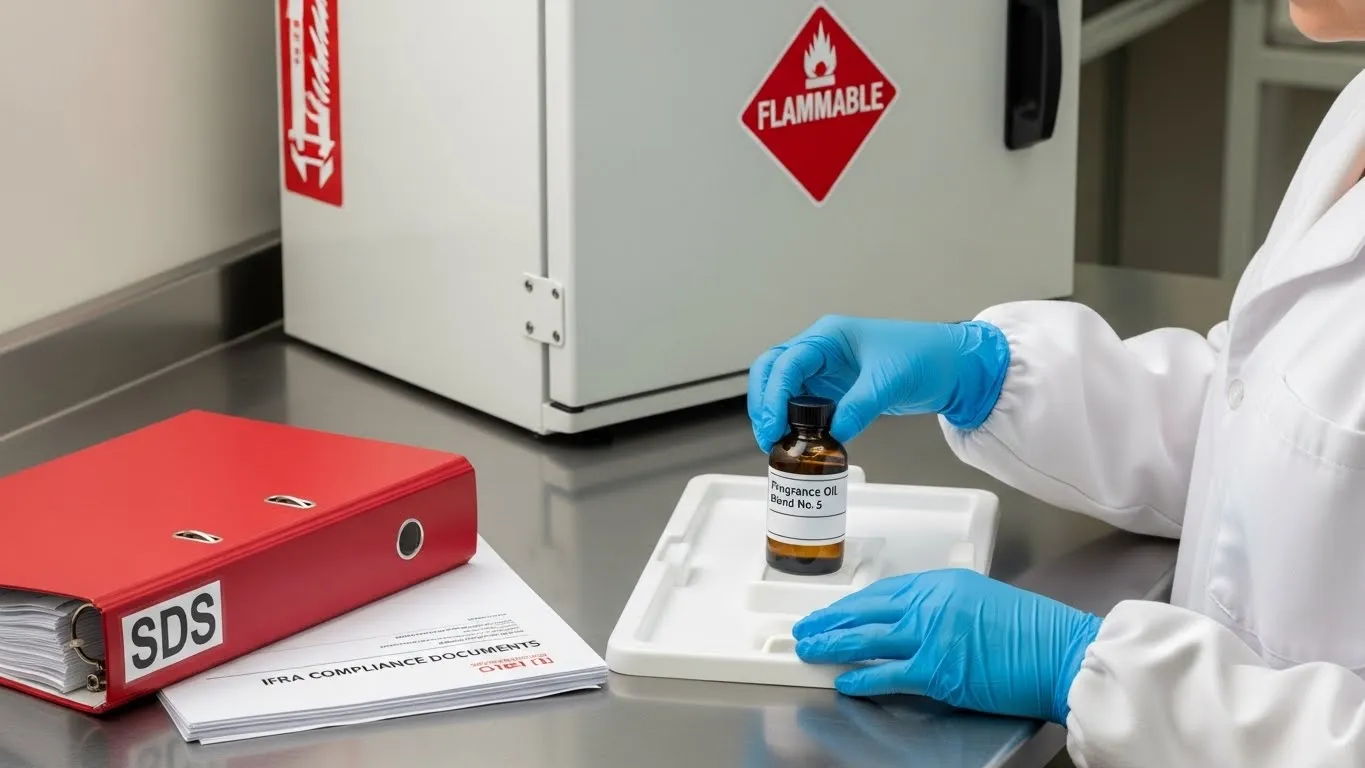
Safety Checklist for B2B Operations
Handling Safety:
- Work in ventilated areas
- Wear nitrile gloves for extended handling
- Use safety glasses when pouring
- Keep away from open flames during handling
- Clean spills immediately
Storage Safety:
- Store in original containers
- Keep in cool, dark location
- Away from heat sources
- Secure from unauthorized access
- Check expiration dates
Documentation Safety:
- Maintain current SDS for all oils
- Keep IFRA certificates on file
- Document usage rates in formulations
- Train staff on handling procedures
IFRA Compliance Requirements
IFRA compliance is mandatory for skin-contact products:
What IFRA Covers:
- Maximum usage levels by product category
- Restricted and prohibited ingredients
- Labeling requirements
- Allergen declarations
Obtaining IFRA Certificates:
Your fragrance supplier should provide IFRA certificates8 showing:
- Maximum usage rates by category
- Any restrictions
- Allergen content
- Compliance status
Common Mistakes to Avoid
Not Testing:
Always test fragrance in your specific base before production.
Ignoring Stability:
Some fragrances work initially but fail over time.
Exceeding IFRA Limits:
Can cause legal and safety issues.
Poor Storage:
Heat and light degrade fragrance quality.
No Documentation:
Records protect your business and enable quality control.
Conclusion
Fragrance oils serve diverse applications from candles to cleaning products, each requiring specific usage rates and safety compliance. B2B buyers should prioritize IFRA-compliant suppliers, proper dilution testing, and application-specific formulations for commercial success.
-
The IFRA Standards Library provides a searchable database of all fragrance safety standards, including maximum usage levels by product category and restricted ingredients for global compliance. ↩
-
Grand View Research’s fragrance market analysis offers comprehensive data on market size, segment shares, and growth projections to help B2B buyers understand industry trends and opportunities. ↩
-
CandleScience’s comparison explains key differences between fragrance oils and essential oils, including performance characteristics, cost considerations, and best applications for each type. ↩
-
This beginner’s guide to soy candle making covers proper fragrance addition temperatures (185°F), cure times (1-2 weeks), and techniques for achieving optimal scent throw. ↩
-
The International Fragrance Association (IFRA) is the global representative body setting safety standards for fragrance ingredients, providing essential compliance guidance for all skin-contact products. ↩
-
New Directions Aromatics’ guide explains how Polysorbate 20 works as a solubilizer to blend fragrance oils into water-based formulations at a 1:1 ratio while maintaining product clarity. ↩
-
This guide breaks down all 16 sections of a Safety Data Sheet, explaining how to interpret hazard information, handling precautions, and storage requirements for fragrance oils. ↩
-
CandleScience’s tutorial explains how to read IFRA certificates, understand product categories, and calculate safe fragrance loads for candles, soaps, lotions, and other applications. ↩